Call Us Today
901 755 4797
A clogged toilet always seems to happen at the worst possible moment. The good news is most clogs are minor, and you can usually clear them yourself with a few household items and a little patience. We’ve been fixing Memphis-area plumbing since 1958, and toilet clogs are still one of the most common calls we get from homeowners in Collierville, Germantown, Bartlett, and Southaven. Below are the steps we recommend trying first, along with the warning signs that mean it’s time to stop the DIY approach and call a professional.
Before you start plunging, take a second to check a few things. A simple clog usually means the water rises when you flush, then slowly drains on its own within a few minutes. If more than one drain in your house is backing up at the same time, if water is backing up into the tub or shower when you flush the toilet, or if you’re hearing gurgling from other fixtures, that points to a blockage further down the line, not just in the toilet bowl. That’s a sign the problem may be in your main sewer line, and no amount of plunging will fix it. We’ll cover what to do about that further down.
Gather these before you start so you’re not searching for supplies mid-clog:
A flange plunger (the kind with an extended rubber flap works best on toilets)
Rubber gloves
Dish soap
A bucket of hot (not boiling) water
Baking soda and vinegar
A toilet auger, if you have one on hand
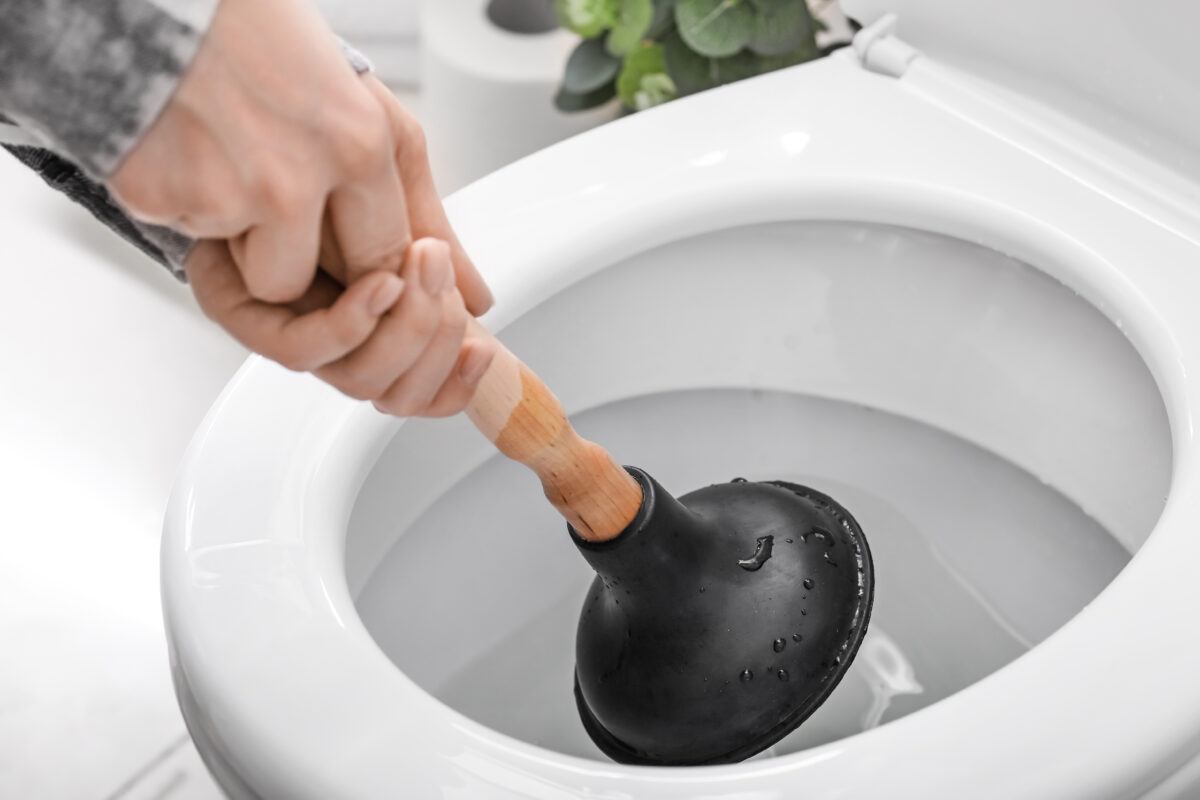
Most toilet clogs clear with a plunger and a little technique.
Get a full seal. Position the flange plunger directly over the drain opening so the rubber fully covers it.
Push down slowly, then pump. The first push should be gentle to force out trapped air. Once you have a seal, pump up and down with firm, steady strokes for 15 to 20 seconds.
Pull up fast on the last stroke. This creates suction that helps pull the clog loose, not just push it further down.
Flush and check. If the water drains normally, you’re done. If it’s still slow, repeat two or three more times before moving to the next step.
If plunging alone doesn’t clear it, dish soap and hot water can help break down and loosen the clog.
Squeeze a generous amount of dish soap directly into the bowl and let it sit for 5 to 10 minutes so it can work its way into the clog.
Slowly pour a bucket of hot (never boiling) water into the bowl from waist height. The combination of heat, soap, and gravity often finishes the job the plunger started.
This is a gentler option that works well on softer clogs like paper buildup.
Pour one cup of baking soda into the bowl.
Follow with one cup of vinegar. It will fizz, which is normal.
Let it sit for 20 to 30 minutes, then flush.
If the clog is still there after the steps above, a toilet auger (sometimes called a closet auger) is your next tool. Unlike a standard drain snake, it’s designed specifically for toilets and won’t scratch the porcelain.
Insert the auger tip into the drain and slowly crank the handle clockwise as you feed the cable in.
Once you feel resistance, keep turning gently. You’re breaking up the clog, not forcing it through.
Pull the auger back out slowly and flush to confirm the water drains freely.
If you’ve worked through all four steps above and the toilet still won’t drain, or if the clog keeps coming back within days of clearing it, that’s usually a sign of something beyond the toilet itself, like a partial blockage in the drain line or an early warning sign of tree roots in an older clay or cast iron pipe. Repeated clogs, multiple slow drains, or sewage odor are not DIY situations. At that point, continuing to plunge or auger can push the real problem further out of reach.
This is where a real inspection matters more than another round of guessing. Rather than just clearing what’s in front of us, we can run a sewer camera inspection to see exactly what’s happening inside the line and show you the footage, so you know precisely what you’re dealing with before any work begins. If the clog is deeper in the system, our drain cleaning services can clear it completely rather than just temporarily.
A few habits go a long way toward keeping your toilets clog-free:
Only flush toilet paper and human waste. Wipes (even “flushable” ones), sanitary products, and paper towels don’t break down the way toilet paper does. We cover the full list of things that should never go down your toilet in this guide to what never to flush down a toilet.
Avoid flushing multiple times in quick succession with heavy paper use, which is one of the most common causes of clogs we see.
If your home has older cast iron or clay plumbing, schedule a periodic inspection. These materials are more prone to buildup and root intrusion over time, and catching a narrowing pipe early is a lot less expensive than an emergency sewer repair.
This usually means the clog is isolated to the toilet’s trap or the short stretch of pipe just past it, not the main line. The steps above (plunger, hot water and soap, baking soda and vinegar, or an auger) should clear it. If it keeps happening in that same toilet specifically, the toilet itself may have a narrow trap or a partial obstruction that a plunger can’t fully reach.
If the bowl is draining slowly but not overflowing, it’s fine to wait until morning. If the water is rising close to the rim, stop flushing it and let it sit. Repeated flushing on a full bowl is what causes overflows, not the clog itself.
We don’t recommend it. A metal hanger can scratch the porcelain glaze inside the bowl, which creates a rough surface where future clogs are more likely to catch. A toilet auger has a protective coating designed specifically to avoid that.
Recurring clogs in an otherwise normal-use toilet often point to something further down the line, like a partial blockage, an aging pipe with reduced flow, or, in older homes, tree roots growing into a clay or cast iron sewer line. That’s not something a plunger fixes long-term. A sewer camera inspection can show you exactly what’s going on before it turns into a bigger repair.
We’d steer you away from those. Most liquid drain chemicals are formulated for sink and shower drains, not toilets, and they can damage the wax ring seal or the pipe itself with repeated use. Baking soda and vinegar are safer options that won’t harm your plumbing.
It depends on what’s causing it, whether it’s a simple removal and reset of the toilet, a deeper line blockage, or a sewer line issue. We’ll always give you clear pricing before any work starts, once we’ve taken a look and shown you what we’re seeing.
If your toilet clog turns out to be bigger than a plunger can handle, or if it’s part of a recurring problem, give us a call. We offer emergency plumbing service around the clock for exactly these situations, and every job starts with a real inspection, not a guess. Homeowners enrolled in our FAM Plan also get priority scheduling and regular plumbing checkups that catch small issues like slow-draining toilets before they turn into bigger repairs.
Call Choate’s today at (901) 755-4797 for plumbing service across Memphis, Collierville, Germantown, Southaven, and North Mississippi.